


How AI Is Improving CGM Predictions and Alerts

If you hear that CGMs now use AI, it is reasonable to wonder what that actually changes for you... Does it make readings more accurate? Does it help predict lows earlier? Or does it mainly affect how alerts behave inside the app?
The reality is practical, not futuristic. AI is already being used inside several CGM platforms to analyse glucose data more intelligently, forecast short-term trends, and decide when alerts should fire. These changes are already live in devices many people use every day.
This article explains how AI is improving CGM predictions and alerts, where that AI sits inside current systems, which CGMs are using it, and why physical wear still plays a critical role.
Where AI fits into a CGM system
AI does not change how a CGM sensor chemically measures glucose in your body. That process is governed by sensor design, calibration, and physiology.
AI sits entirely in the software layer, where glucose data is:
- Aggregated across time
- Analysed for patterns
- Used to estimate short-term future trends
- Translated into alerts and insights
In simple terms, AI improves interpretation, not measurement.
This distinction is important from a medical safety perspective. AI-supported CGMs remain decision-support tools, not decision-makers.
How predictive algorithms differ from traditional alerts
Earlier CGM alerts relied on static thresholds. When glucose crossed a set number, an alert triggered.
AI-driven systems increasingly use predictive algorithms, which estimate where glucose is heading based on:
- Rate of change rather than absolute value
- Shape and acceleration of recent trends
- Repeated outcomes at similar times of day
- Responses observed in similar past situations
This approach aligns with international CGM guidance on trend-based data interpretation, outlined in clinical targets for CGM data interpretation.
This shift is central to how AI is improving CGM predictions and alerts, particularly for overnight lows and delayed post-meal rises where timing matters.
How Dexcom uses AI in its CGM apps
Dexcom has taken a clear step forward by launching a generative AI platform for glucose biosensing.
According to Dexcom’s announcement on its generative AI glucose biosensing platform, this technology is designed to:
- Analyse long-term CGM datasets rather than isolated days
- Generate personalised insights instead of static summaries
- Support predictive alerts such as urgent low soon warnings
- Help explain why patterns may be occurring, not just show that they exist
Importantly, Dexcom positions this AI as assistive, not directive. It does not tell users how to dose insulin or replace clinical advice.
These predictive features depend heavily on uninterrupted data. Signal gaps caused by early lift or sensor movement weaken forecasts, which is why many users focus on how long a CGM patch should last and signs a CGM patch is too weak for daily life.

How Freestyle Libre uses AI-assisted pattern recognition
Abbott has introduced Libre Assist, an AI-supported feature focused on insight rather than automation.
As described in Abbott’s overview of Libre Assist, AI is used to:
- Identify recurring glucose patterns across days and weeks
- Highlight trends that are clinically meaningful
- Provide context-aware insights linked to timing and behaviour
While Freestyle Libre systems do not currently use generative AI in the same way as Dexcom, they apply machine learning to trend analysis and predictive low alerts in supported models.
These insights become more reliable when wear is consistent, which is why setup and placement matter, as discussed in your first Freestyle Libre sensor and why Freestyle Libre 2 and 3 readers are changing the game.
How Medtronic applies AI to prediction and automation
Medtronic applies AI most extensively when CGMs are paired with automated insulin delivery systems.
According to Medtronic’s overview of AI in healthcare technology, AI supports:
- Short-term glucose forecasting
- Hypoglycaemia risk modelling
- Automated insulin adjustments within defined safety limits
- Alert prioritisation based on likelihood of required action
Because these systems rely on continuous signal quality, users often pay close attention to adhesion and movement, covered in protecting Medtronic Guardian sensors.
Why AI performance still depends on physical wear
Even the most advanced AI cannot compensate for missing or unstable data.
Research into machine learning for CGM glucose prediction shows that data continuity directly affects forecast reliability.
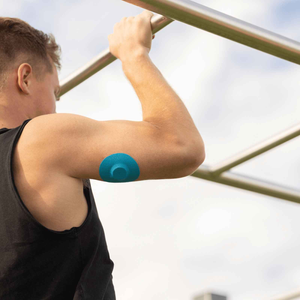
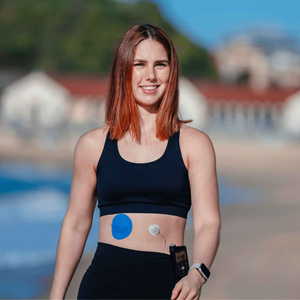
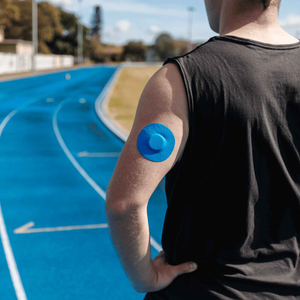
Signal loss caused by patch lift, moisture, or early removal reduces the effectiveness of predictive alerts. This is why many experienced users quietly reinforce sensor stability with
Type Strong CGM patches, especially during summer, travel, or high-movement routines.
This link between wear and data quality is also explored in why CGM sensors need extra protection in summer and how exercise can loosen a CGM patch. For users with sensitive skin, pairing patches with skin adhesive wipes can also help maintain adhesion without increasing irritation.
Medical and safety disclaimer
AI-supported CGM features are decision-support tools only. They do not replace:
- Fingerstick confirmation when symptoms do not match readings
- Clinical advice from a healthcare professional
- Individual judgement based on how you feel
Always follow your prescribed diabetes management plan and consult your care team before making treatment changes.
AI and alert fatigue
AI is also being used to optimise alert behaviour, not just predict glucose.
By learning how users respond to alerts, AI can:
- Reduce repeated alerts that are consistently ignored
- Adjust timing for predictable patterns
- Emphasise alerts that usually lead to action

This does not remove alerts. It aims to make them more relevant, a balance explored further in managing diabetes burnout with tech habits.
What this means in practice
AI is improving CGM predictions and alerts in specific, practical ways that already exist in real devices. Earlier warnings. Smarter alerts. Better pattern recognition.
When sensors stay secure and data remains consistent, AI-supported CGMs can feel less reactive and more supportive of everyday life.
You remain in control. The technology is learning how to assist, not decide.
References
Abbott, 2024. Libre Assist. Abbott Diabetes Care.
Available at: https://www.freestyle.abbott/us-en/libre-assist.html
Battelino, T., Danne, T., Bergenstal, R.M., Amiel, S.A., Beck, R., Biester, T., Bosi, E., Buckingham, B., Cefalu, W.T., Close, K.L. and Cobelli, C., 2023. Clinical targets for continuous glucose monitoring data interpretation. Diabetes Care, 46(10), pp. 2226–2234.
Available at: https://diabetesjournals.org/care/article/46/10/2226/153920
Dexcom, 2024. Dexcom launches the first generative AI platform in glucose biosensing. Dexcom Investor Relations.
Medtronic, 2024. Artificial intelligence in healthcare technology. Medtronic.
Available at: https://www.medtronic.com/en-us/our-company/ai-healthcare-technology.html
Zhu, T., Li, K., Herrero, P. and Georgiou, P., 2022. Machine learning for glucose prediction using continuous glucose monitoring data. Sensors, 22(3), 1035.
Available at: https://www.mdpi.com/1424-8220/22/3/1035


